An e-portfolio of my publications and presentations in the world of Academia. My current work focuses on the fundamental re-design of learning environments in light of dramatic changes in our understanding of the physiology, neuroscience of learning and the exponential growth of digital culture. I wish to recognize opportunities for innovation in different learning environments while employing good working practice to encourage healthy lifelong learning for both teachers and students.
Dear Conference Attendees, Presenters, Sponsors, and Invited Speakers,
Congratulations and thank you for contributing to the success, tremendous energy and enthusiasm that you brought to the conference this year, JALTCALL 2026, June 12th-14th (Nishinomiya), near Kobe, Japan. Hosted on the Edzilla Platform
Under the theme “Prevail or Fail?”, we at JALTCALL invited educators, researchers, and technologists to explore how digital tools, pedagogical innovations, and AI are reshaping language teaching and learning in an age of rapid change and uncertainty. We welcomed presentations that critically examined both successes and setbacks in technology-enhanced language education—projects that worked, those that didn’t, and lessons learned in between. Topics included experimental classroom applications, data-driven research, AI and VR integration, assessment and feedback innovations, teacher training, learner autonomy, and institutional implementations. Whether projects prevailed, failed, or continue to evolve, we encouraged honest reflection, rigorous analysis, and forward-looking discussion on what “success” really means in the CALL field today.
Our THEMATIC STREAMS were...
Machine Learning in CALL (ML)
Digital game-based language learning and teaching (DGBLLT)
Classroom application of CALL
Ethics and Policy in CALL practice
Extended reality (XR) in CALL (including virtual (VR), augmented (AR), and mixed reality (MR))
Learner motivation and CALL
Second language acquisition (SLA) theory and CALL
Virtual exchange & COIL
Mobile Assisted Language Learning (MALL)
Technology-mediated feedback
Social Media
Software development
General CALL
We all thoroughly enjoyed the Networking Dinner & Snacksall of which are included with the conference tickets. Our Saturday and Sunday Snacks included tea, coffee, hot chocolate, a range of soft drinks, and fresh, healthy fruit and nut options. Our Networking Reception Dinner (Saturday evening) began with a sake tasting toast and speech from the local brewer, 6.30 pm to 8.30 pm, after the Saturday keynote speech with Brent Warner. A range of foods and drinks were served on the 5th-floor atrium next to where the sponsors, snacks, and poster sessions were during the conference.
In her Sunday keynote, Mehrasa reflected on her past work with immersive technologies in language education, examining not only what prevailed, but also what failed, and how she attempted to address these challenges. By critically engaging with initiatives that did not unfold as planned, she highlighted key pedagogical and practical lessons drawn from these experiences. She also demonstrated how these insights have directly informed the design and direction of her current project, offering a reflective account of how learning from failure can ultimately help innovation prevail in technology-enhanced language learning.
Brent Warner is an award-winning professor at Irvine Valley College in southern California, where he focuses on integrating technology into the language learning process. He works with teachers and organizations across the globe to provide practical advice for helping English Language Learners take advantage of tech to help them communicate more clearly. For TESOL International, he blogs about technology integration in the ESOL classroom; he is also the co-host of The DIESOL Podcast, which addresses innovation in ESOL, as well as The HigherEdTech Podcast, covering tech for teachers in college and university settings.
Invited Speakers & Forum
This year we also invited a number of speciality speakers from a range of fields to give dedicated talks, plus a small number of focused forums. Tom Legge President SA-SIGa tenured lecturer in the Faculty of Business Administration at Momoyama Gakuin University. He is a graduate of the London School of Economics and The Open University. He teaches courses in international business and study abroad preparation and leads a seminar entitled “Global Mobility”, which focuses on overseas study, working holidays, and international career pathways. He is a strong advocate and facilitator of on-campus intercultural exchange between Japanese and international students. His research focuses on study abroad, working holiday programmes, and IELTS. His recent work includes An Exploration of Japanese Working Holidays: Trends, Motivations, and Challenges, which examines participation patterns and the structural and employment-related challenges faced by Japanese working holiday participants. He is president of the JALT Study Abroad Special Interest Group.
Speaking on “Designing Intercultural Exchange through CALL: Lessons from an Online Study-Abroad-Inspired Programme". For many students, technology is opening up learning experiences that would previously have required travel, resources, or opportunities that are no longer easily available. This presentation reflects on the design and implementation of an online study-abroad-inspired program that aimed to recreate some of the core experiences of study abroad (most notably interaction with people from different cultural backgrounds) through synchronous online classes.
The Japan Exchange and Teaching (JET) Programme is an initiative that aims to enrich Japan’s foreign language education and promote internationalization by inviting young adults from around the world to be employed by local governments and related organizations in Japan. The program was established in 1987, with 848 participants from four countries. Since then, the number of participants has increased significantly, with over 5,000 participants from 57 countries at present. The JET Programme is administered through the collaboration of Japan’s Ministry of Internal Affairs and Communications (MIC), Ministry of Foreign Affairs (MOFA), Ministry of Education, Culture, Sport, Science and Technology (MEXT), and the Council of Local Authorities for International Relations (CLAIR).
This poster presentation explained how to create text analysers using Claude AI to write the code necessary. With some specific prompt engineering, the AI can be trained to produce tools that give highly specific feedback in formats that are clean and crisp. With only a few simple steps in the vibe-coding process, the poster will demonstrate both early (simple scoring and word counting) and more developed examples (descriptive feedback comments, APA corrections, Fry Readability and CEFR scores) that were created in just a few minutes to great effect (detailed tailored feedback output). Attendees who bring an internet-ready device should be able to create a running analyzer on the spot and test it out immediately. The presentation also showed examples of output from each of the engineered analyzers with clearly defined limitations and possibilities of the tool Claude AI that is free to use and easily adaptable and embeddable to your service of choice or within its own system. No previous coding skills are necessary, but the created code were be displayed for all to see and share via QR codes.
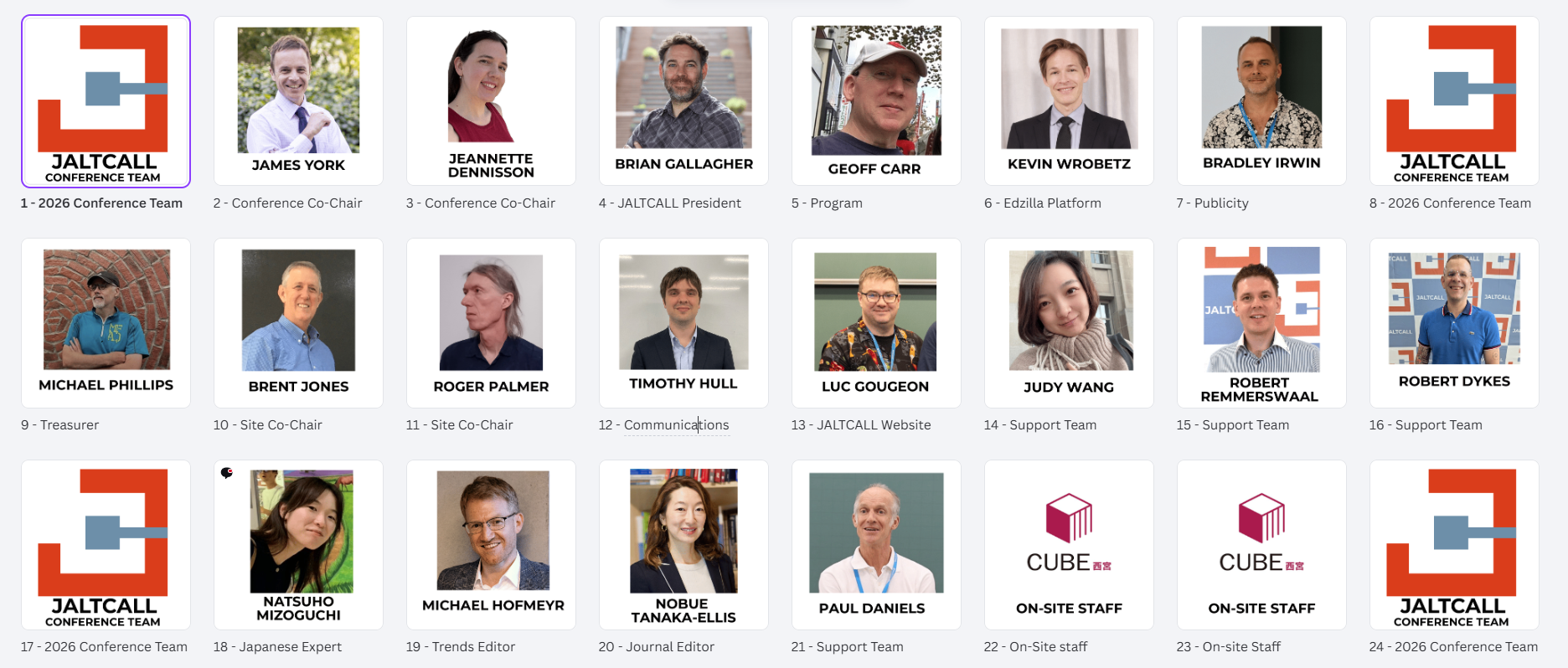
Our 2026 conference team were...
Conference Chairs James York (Meiji University, Tokyo) and Jeannette Dennison (St. Marianna University) Listen to their JALTCALL Podcast interview from Feb, 2026 Site Chairs Roger Palmer (Konan CUBE University) and Brent Jones (Konan CUBE University) Listen to their April 2026 JALTCALL Podcast interview here. President Brian Gallagher (Meijo University, Nagoya) Treasurer Michael Phillips (Ritsumeikan Asia Pacific University) Program/Schedule Chair Geoff Carr (Asahikawa City University) Publicity Bradley Irwin (Kyoritsu Women’s University, Tokyo) Edzilla Site Management Kevin Wrobetz (Kobe Gakuin University) Trends Publication Michael Hofmeyr (Tokyo University of Science) JALTCALL Website Luc Gougeon (Sojo University) Japanese Language Coordinator Natsuho Mizoguchi (Nagoya University of Foreign Studies) Support Team Reviews / Correspondence / Support / Scheduling / etc. Susan Meiki [sponsors] (Okayama University), Paul Daniels (Kochi University of Technology) Robert Remmerswaal (Sojo University, Kumamoto), Timothy James Hull (Sojo University, Kumamoto), Yoko Takano (Meijo University, Nagoya), Judy Wang (Hosei University, Tokyo) Photographers Tim Cleminson & Robert Moreau
and our helpful student volunteers from Konan University CUBE

 Machine Learning in CALL (ML)
 Digital game-based language learning and teaching (DGBLLT)
 Classroom application of CALL
 Ethics and Policy in CALL practice
  Extended reality (XR) in CALL (including virtual (VR), augmented (AR), and mixed reality (MR))
 Learner motivation and CALL
 Second language acquisition (SLA) theory and CALL
 Virtual exchange & COIL
 Mobile Assisted Language Learning (MALL)
 Technology-mediated feedback
 Social Media
 Software development
  General CALL



 Listen to their JALTCALL Podcast interview from Feb, 2026
/OpenOffice.org%203/Basis/share/gallery/rulers/blurulr1.gif)
Comments
Post a Comment